
Net Friends has been a Durham-based business for almost 30 years. We have experienced many regional disasters. We witnessed severe ice storms that struck in 2002, 2016, 2018, and 2021, closing schools and businesses, shutting down parts of I-40, and causing widespread power and water outages. Tornados have hit our area too. Coincidentally, all in the Aprils of 2011, 2018 and 2020. We have even had our share of strong hurricanes this far inland, with Hurricanes Floyd (1999), Isabel (2003), and Matthew (2016) causing structural damage, flooding, and power outages for hundreds of thousands of residents and businesses. And who can forget the Great Blizzard of 2000, also known as the Snowmageddon or Snowpocalypse, which dumped 20 inches of snow fall in a single day?
Each of these storms hit our region hard, causing loss of life, significant damage to our infrastructure, and widespread disruption to our community. Stepping back and looking at all the regional disasters that have visited us over the past 25 years, it is apparent that major weather events are inevitable and common.
Every season brings a unique threat, whether there are tornadoes in the spring, ice storms in the winter, or hurricanes and violent storms in the summer and fall.
Other regions of the country contend with their own set of regional disasters, such as forest fires, earthquakes, and landslides. As staff and customers are more widespread, the benefits of our geographical distribution are offset by the wider realm of disruption that businesses must consider.
Based on where your business is located, how likely do you think a regional disaster will occur in the next 12 months? How about over the next 3 years, or 5 years? As you stretch out the timescale, the likelihood of disruptive incidents gradually increases.
Why Businesses Need a Response Plan
All businesses should regularly assess the impact of a regional disaster on their daily operations.
- How sensitive are you to disruptions to your supply chain?
- How vulnerable is your business to a power outage, especially if it lasts more than a week?
- How much would your staff be impacted by a major event that prevents them from on-site or remote work?
- How likely will your customers be delayed from receiving your services or purchasing your goods?
Every business needs a response plan so they can be proactive ahead of a severe storm, as well as prepared with a playbook to address every foreseeable business continuity risk.
Our Approach to Assessing Risks
At Net Friends, we assess the risks of a regional disaster in two primary ways: first look at overall business risks, then contextualize those risks based on what is most critical to your business.
At Net Friends, we assess the risks of a regional disaster in two primary ways: first look at overall business risks, then contextualize those risks based on what is most critical to your business.
As an example of how to consider risks from an asset-based perspective: our corporate headquarters in Durham. This office is important to our operations. Given historical weather trends, we assess a high likelihood of a major regional disaster impacting the site within the next five years, which demands proactive preparation
Risks: The loss of utilities and structural damage.
Mitigations: We have mitigated potential power disruptions by installing and maintaining a generator and mitigating our loss of network access by having redundant ISP connections. Our insurance adequately covers our physical assets.
The generator represents a first party risk mitigation, and insurance represents risk transference or third-party risk mitigation.
sets. The generator represents a first party risk mitigation, and insurance represents risk transference or third-party risk mitigation.
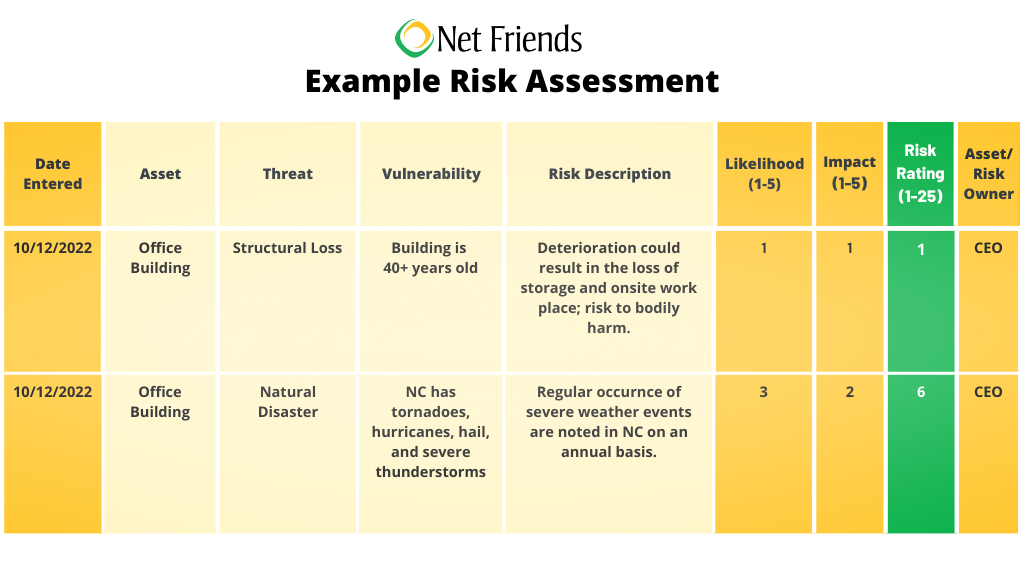
Asset-based risk assessments are critical for every business and help you identify and protect your most valuable property and resources. Download this template.
While every business should conduct these types of risk assessments annually, at Net Friends we go one step further and perform a less common form of risk assessment: a Business Entity Risk Assessment. This type of assessment takes on a broader approach to risk, expanding beyond simply tying them to a specific asset or set of assets.
Notice how narrow the threat and impact assessment of a regional disaster comes when seen solely through the lens of a single asset: our building. The impact on our remote staff, the impact on the broader community and infrastructure (e.g., roads, power grid, food, and water supplies), and the customer-facing impacts are not adequately considered.
When unidentified risks are overlooked, they will remain unmitigated and potentially grow into an even bigger risk over time and as the business scales.
When you conduct a proper Business Entity Risk Assessment, it becomes clear that just buying insurance and a generator cannot count as a comprehensive risk mitigation plan. We need to consider:
- How to effectively communicate with staff and customers before, during, and after a regional disaster and put those communication plans in place.
- Ensure HR policies are in place and staff are trained for expectations around regional disasters, like identifying essential personnel and procedures for handling prolonged work disruptions.
- How to support our customers will need our support as well during a regional disaster, as the event will affect us all.
Developing and implementing a plan to maintain essential services during a storm or crisis is a complex and time-consuming process.
.png)
Boost Your Resiliency
Your customers and staff depend on your business, and you need to bounce back quickly whenever disaster strikes. Performing these assessments will make it clear what you need to prioritize to mitigate risks to your business. It is satisfying work, and it is one of those processes that ensure you are working “on the business” vs. only “in the business.”
When you demonstrate a proactive stance for disaster response, you will boost your reputation and status as a well-run organization. Your customers will be impressed. Your staff will feel valued and show pride around being a part of your team. Simply put, spending the time to consider risks increases your chances of being successful as a business.
Strengthen Your Security and Resilience with NetSafe Strategy
Net Friends offers comprehensive guidance to significantly reduce your risks and increase your business resiliency.
On aspect of our NetSafe Strategy service is designed to take you through the essential steps:
- Conduct a Risk Assessment: Identify and analyze your specific vulnerabilities.
- Create a Risk Register: Document and prioritize identified risks.
- Build an Incident Response Plan: Ensure you are prepared to handle a wide spectrum of events and lock in your resilience.
NetSafe Strategy provides your business with the vital framework and guidance needed to confidently weather through a wide spectrum of risks.
Reach out to us today to get started! Let’s build a better future together.
Follow us on LinkedIn!
WHAT TO READ NEXT:
- Weathering the Storm: Safeguarding Your Business with Hurricane IT Readiness
- Why You Need Technology Business Reviews
- Server Hardening 101: Boosting Business Security

Take IT Off Your To-Do List.
Tech holding you back? Losing productivity to downtime?
Discover how we can simplify your tech and free up your time, contact us today.
At Net Friends, we believe in the power of human expertise. While we leverage AI to enhance our content and processes, all blog posts are written and edited by our knowledgeable staff. You can trust you are getting insights directly from our team.