
What you need to know:
- AI Adoption is a Business Transformation: Tools like Copilot and Gemini require a deliberate, comprehensive business strategy and executive buy-in, going far beyond a simple IT upgrade.
- Preparation Starts with an AI Readiness Survey: Assess the current state (strategic, technical, cultural) of your business to create a roadmap before deployment.
- AI Acts as a Security Magnifier: AI inherits existing permissions. Any pre-existing security flaw or data access issue is instantly magnified.
A successful enterprise adoption of powerful generative AI tools like Microsoft Copilot or Google Gemini is not simply a matter of licensing new software; it is a foundational business transformation. These tools operate by accessing and synthesizing an organization's internal data and require deliberate and comprehensive preparations to ensure they deliver maximum value while maintaining security and compliance.
The first critical step in this journey is conducting a thorough AI Readiness Survey. Such an assessment evaluates the current state of the organization across key strategic, technical, and cultural dimensions. The insights gathered from this survey form the basis of a tailored roadmap, allowing the enterprise to strategically close gaps before deployment.
There are four essential pillars that define an organization's preparedness for AI adoption. These pillars move beyond basic technical requirements to cover the full lifecycle of a successful AI initiative, from executive alignment to post-deployment change management.
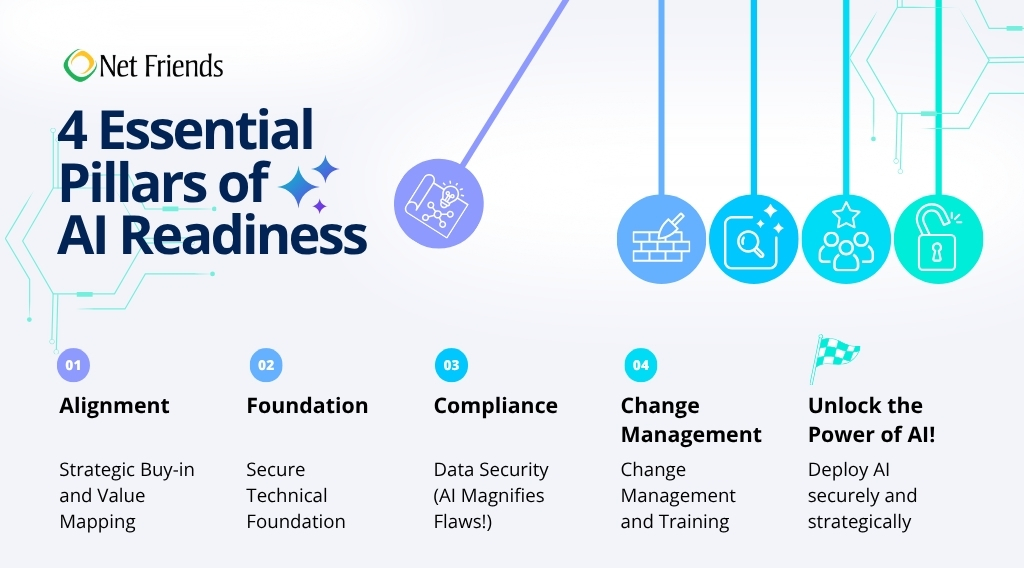
Pillar 1: Business and Strategic Alignment
This first pillar establishes that AI adoption is a strategic business imperative, not just a technology upgrade.
- Leadership and Buy-in: Complete executive leadership buy-in is non-negotiable for success. A lack of support will inevitably lead to a fractured, under-resourced initiative.
- Cultural Readiness: An effective deployment strategy includes measuring employee interest to foster an organizational culture that exhibits low resistance to AI tools.
- Strategic Mapping: The organization must clearly articulate where and how AI will create value. This means mapping AI capabilities directly to specific business problems to ensure the technology solves real problems rather than serving as a novelty.
- Value and Risk Assessment: Readiness requires a deep understanding of the AI tool’s business value and risks. This involves a clear-eyed ROI analysis weighed against the potential for errors, "hallucinations," and compliance failures.
- Strategic Integration: Finally, readiness is cemented by establishing clear usage guidelines that formally embed AI into documented firm strategy, moving it beyond an experimental status.
Pillar 2: Licensing and Technical Foundation
While strategy provides the "why," the Technical Foundation dictates the essential "how." AI tools like Copilot and Gemini are an overlay built upon your existing technology ecosystem, meaning the strength of this foundation directly determines the success of the AI layer. These tools work optimally when they can reliably index and access organizational data across your services, creating a unified and coherent knowledge graph.
Furthermore, technical readiness requires that the tenant is current and securely managed. When a powerful search and synthesis tool is introduced, outdated configurations, patchwork security settings, or unmanaged data sprawl create significant, unforeseen security and data access risks.
A strong, well-governed technical foundation minimizes deployment friction, maximizes AI performance, and ensures data integrity.
Pillar 3: Data Security and Compliance
The successful and secure implementation of an imbedded AI tool like Microsoft Copilot or Google Gemini hinges on the integrity of the internal data.
These tools operate strictly within the existing security boundaries and defined permissions. It does not introduce new access controls. Rather, it inherits and acts upon the current state.
This makes these tools a security magnifier:
- Magnification of Flaws: Any pre-existing security flaw, such as overly permissive access, broken inheritance, or "stale" public file links, is instantly magnified. These tools can efficiently retrieve and synthesize data from all sources it can access on the user's behalf, regardless of how sensitive that data is.
- The "AI Does Not Know" Problem: If a user has accidental access to sensitive files (e.g., salary information, proprietary contracts, or employee reviews), AI tools will not recognize this access as an error. It simply executes the request based on the user's entitlements within the data set. Consequently, a user could ask, "What is the average salary in the sales department?" and the AI would answer using the accidentally accessible spreadsheet.
Pillar 4: Change Management
Change Management is the final, crucial pillar that ensures technical readiness translates into practical adoption and realized value.
Key Readiness Components for Change Management:
- Communication Plan: Launch with a phased introduction and a clear communication strategy that focuses on employee empowerment.
- Context-Specific Training: Develop a comprehensive training program focused on integrating Copilot into existing workflows. Training should move beyond general features to provide context-specific instruction.
- Identify Champions and Early Adopters: Select and empower change champions within the organization. These individuals are key to evangelizing the technology, providing peer-to-peer support, and normalizing the use of the new tools across departments.
- Define Success Metrics: To ensure the investment yields a return, establish clear metrics for adoption success. Focus on qualitative improvements such as time saved on specific, high-value tasks, or demonstrable improvements in accuracy or quality.
- Establish Feedback Loops: Establish reliable feedback loops to capture employee experiences, measure real-world impact, and iteratively adjust policies, training, and support materials based on the data.
Unlock the Power of AI
Successful AI integration requires strategic readiness, not just simple adoption. The journey begins with a comprehensive AI Readiness Survey. Successful AI integration is the direct result of deliberate, informed, and proactive preparation. Is your organization truly ready to deploy AI securely and strategically?
Take the next step: Don't wait for issues to surface. Book a meeting with the IT Experts at Net Friends today to review your AI Readiness Survey results and develop a tailored roadmap for secure and high-value AI deployment.
Follow Us on LinkedIn!
More Reading:
- Responsible AI Implementation
- Microsoft Copilot is Revolutionizing Business
- 5 Data Privacy Best Practices for AI Users

Take IT Off Your To-Do List.
Tech holding you back? Losing productivity to downtime?
Discover how we can simplify your tech and free up your time, contact us today.
At Net Friends, we believe in the power of human expertise. While we leverage AI to enhance our content and processes, all blog posts are written and edited by our knowledgeable staff. You can trust you are getting insights directly from our team.