
Every business collects customer data. Names, emails, payment details, browsing habits, and support tickets. Larger companies often have dedicated teams to manage this information carefully. Most small businesses collect it gradually, a bit at a time, across different tools and systems. Often there is no clear picture of where it is all being stored and protected.
That gap is riskier than it feels day to day. Estimates for small business breach costs vary, but most trackers put a typical incident somewhere between $120,000 and $1.2 million, (Source: IBM Cost of a Data Breach Report 2026) and a lot of contained breaches land in the $150,000 to $250,000 range (Source: Total Assure Cyber Attacks on Small Businesses Statistics 2026). For a business running on a few million in revenue, it can eat a year of profit or end the business entirely. 50% of small businesses close after a breach (Source: National Cyber Security Alliance).
This is exactly why protecting your data is a core business strategy. Attackers target companies because their defenses are weak, and small businesses often have the least in place to stop them. On top of the direct costs, a breach chips away at something harder to rebuild than a bank balance, your customers' trust.
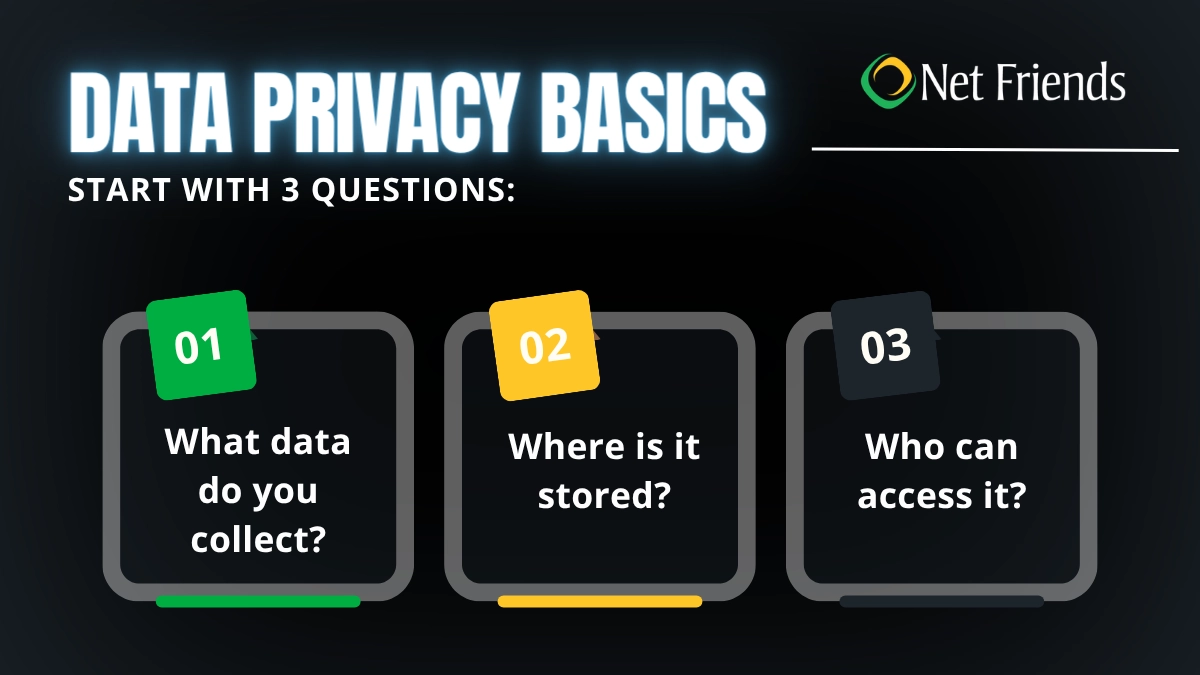
The good news is that most of this risk comes from not knowing what you have, not from some unstoppable attack. Knowing what you collect, where it lives, and who can touch it is what allows you to develop strategies to protect your data.
Start With the What
The first step is a data inventory. What information do you gather from customers, why do you need it, and where does each piece end up once it is collected? If you can't answer those questions with confidence, it is time for a data audit.
Knowing your data is like knowing your ingredients before you cook. You can't make a safe meal, or a safe system, if you are not sure what's in the pot. This connects to a legal principle called data minimization. Only collect personal data that is necessary for a specific purpose, not just in case we need it later.
Net Friends Pro-Tip: A data inventory is a living document and needs to be reviewed on a regular basis.
Then Ask Where
Once you know what you have, it is time to figure out where it lives. Is it in a properly secured cloud database, or scattered across spreadsheets on someone's laptop? Are backups encrypted, or just sitting there hoping nobody notices?
This matters more than it might seem. IBM's research has found that breaches spanning multiple environments (say, a mix of cloud and on-premises systems) cost noticeably more to clean up than breaches confined to a single, well managed system. A single location is easier to protect. Basic hygiene here includes encrypting data both at rest and in transit and setting retention schedules, so old data gets deleted.
Good storage practices give you a clear answer if the auditor or clients ask how their data is protected.
Finally, the Who
This is where privacy problems most often start. Most breaches start with an employee who kept access to a system they no longer use, or a vendor who was handed broad permissions years ago and never had them revoked. IBM's 2025 report found that breaches involving malicious insiders were among the costliest of all.
The fix is what principle security teams call least privilege. People and systems should only have access to the specific data they need for their specific job. Marketing does not need billing records. Support doesn't need to see internal financial reports. Role based access control (RBAC) is the standard way to enforce this at scale, since it ties permissions to job function rather than handing them out one request at a time.
Net Friends Pro-Tip: Make access reviews a regular habit. Roles and data needs change over time, but access does not always get updated to match.
Why This Matters
Knowing what you collect, where it is stored, and who can access it is the backbone of both security and compliance.
From a security standpoint, you cannot protect what is not understood. Unmonitored, forgotten systems are exactly what attackers look for, since nobody's watching them for suspicious activity.
From a compliance standpoint, regulations are built entirely around these questions. What data do you have, why do you have it, and who can touch it. Documenting and managing data security is required.
There is a trust angle too. Customers notice when companies handle their data carelessly and being able to show what you collect and how you protect it is a differentiator.
Building Better Habits
Data privacy gets a lot less overwhelming once you break it into three questions. What are we collecting, where does it live, and who can access it. Answer those honestly and keep revisiting them, and most of your compliance and security work takes care of itself.
Think of it as swapping the junk drawer for a proper filing cabinet. A little organization now saves you a much bigger mess later.
Need help? Book a meeting with one of our IT Experts and we can help you elevate your security.

Take IT Off Your To-Do List.
Tech holding you back? Losing productivity to downtime?
Discover how we can simplify your tech and free up your time, contact us today.
At Net Friends, we believe in the power of human expertise. While we leverage AI to enhance our content and processes, all blog posts are written and edited by our knowledgeable staff. You can trust you are getting insights directly from our team.