
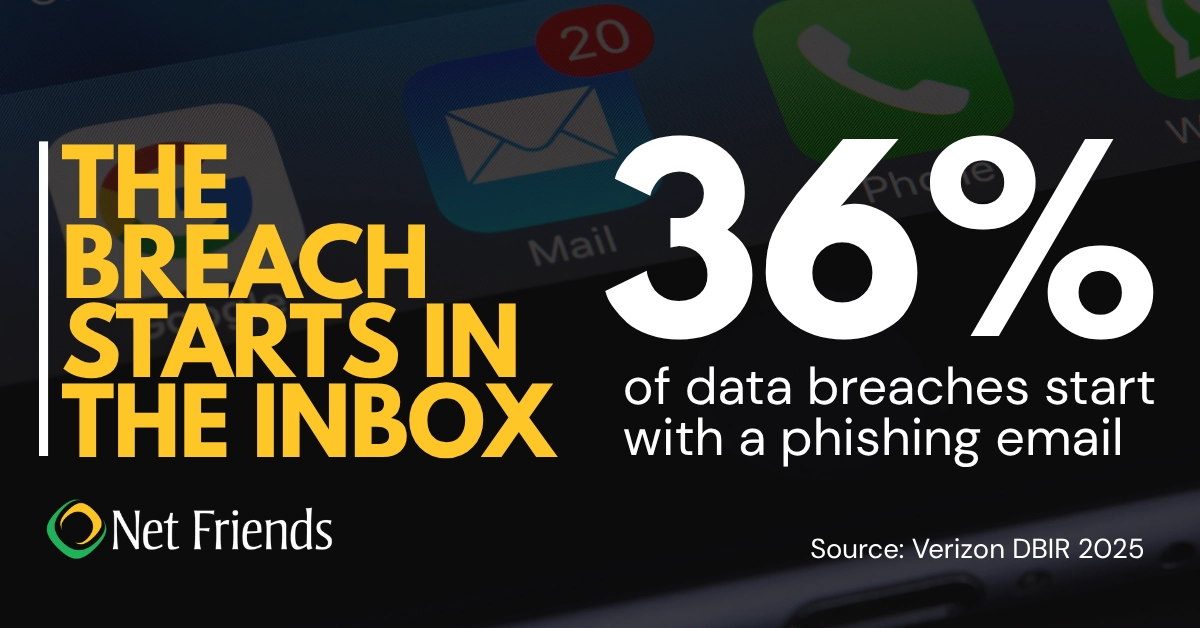
Phishing is the number one way businesses get breached. In fact, 36% of all data breaches start with a phishing email. Add in the 3.4 billion phishing emails sent worldwide every single day, and it's clear these attacks aren't something you can simply dodge.
To make things trickier, AI now makes it easier than ever for attackers to write personalized, polished phishing emails that feel legitimate. That means employees need to be sharper than ever at sniffing out phishing and knowing exactly what to do the moment they spot it.
Case Study One - The Invoice That Wasn't Really the Vendor
A small landscaping company worked with the same supplier for years. One afternoon, the bookkeeper got an email that looked exactly like the supplier's usual invoice format. It mentioned a recent project by name and asked that the next payment go to an updated bank account.
The bookkeeper made the transfer. $18,000 later, the real supplier called asking why their invoice had not been paid. The email had come from a lookalike domain, one letter off from the real one, and the attacker had clearly been watching the company's email traffic for weeks to time the request perfectly.
This is a classic case of Business Email Compromise, and it works because it borrows something the company already trusts, a familiar name and a familiar routine, and just quietly changes one detail.
Case Study Two - The Payroll Update That Wasn't Really HR
A small dental practice was switching to a new payroll provider, and staff had already been told to expect some emails about it. A few weeks in, an employee got a message that looked like it came from HR, with the practice's usual logo and signature, asking everyone to reconfirm their direct deposit details through a linked form before the next pay run.
The employee filled it out without a second thought. It felt like just another piece of onboarding paperwork, the kind of task people click through on autopilot. Two weeks later, on payday, the deposit never showed up. By the time anyone traced it, the money had gone to an account that had nothing to do with the new payroll provider.
This one is sneaky because it does not ask for anything dramatic. It hides inside a mundane administrative task, arrives at a moment when a real system change made the request believable, and asks people to do something they already expected to do anyway.
Case Study Three - The Login Page That Looked Real
An employee at a small law firm got an email saying her email password was about to expire, and she needed to log in to keep her account active. The page she landed on looked identical to her usual login screen, right down to the logo.
She typed in her credentials. Within hours, the attacker was inside her real inbox, reading client emails and sending convincing follow up messages to coworkers, since the messages now came from her actual account.
This one is dangerous because it doesn't stop at one person. Once an attacker has a real inbox, they can launch new attacks from inside the company's own trusted circle.
What These Stories Have in Common
Each of these scams worked by exploiting three ordinary human instincts, trust in familiar routines, respect for authority, and a desire to help quickly. None of them required advanced hacking. They required patience, research, and a moment where someone didn't pause to double-check.
How Training Changes the Outcome
Training also builds something just as valuable as knowledge, a reporting culture. When employees feel comfortable saying "this email looked a little off, can someone check it," problems get caught in minutes instead of after a wire transfer clears. Regular phishing simulations, where employees receive harmless test emails designed to mimic real scams, are especially effective. They turn "I read about phishing once" into "I've actually caught one of these before."
The Return on Investment
Cybersecurity training for a small business typically costs far less than a single incident like the ones above. An $18,000 wire transfer loss, a breached client inbox, or the reputational damage of telling customers their data was exposed, eclipses the cost of an annual training program.
The goal is not to turn every employee into a security expert. It is to give them a few reliable instincts, a habit of double-checking urgent requests, a healthy suspicion of updated bank details, and the confidence to ask questions before clicking. Those instincts stand between a normal Tuesday and a very expensive one.
Phishing will keep evolving, but so can your team. If you're ready to bring cybersecurity training to your company, book a meeting with one of our IT experts today.
More Reading
How Training Impacts Identity Theft
Why Cybersecurity Training Is Important for Compliance
Top 5 Cybersecurity Steps

Take IT Off Your To-Do List.
Tech holding you back? Losing productivity to downtime?
Discover how we can simplify your tech and free up your time, contact us today.
At Net Friends, we believe in the power of human expertise. While we leverage AI to enhance our content and processes, all blog posts are written and edited by our knowledgeable staff. You can trust you are getting insights directly from our team.